



5-HT6 Receptor
5-HT6 receptor is a serotonin receptor family member with almost exclusive CNS expression, abundant in limbic and cortical regions[1]. Mechanistically, 5-HT6 receptor research links the target to regulation of glutamatergic and cholinergic neuronal activity, with reported roles in cognition, feeding, affective state, and seizures[1]. Its pharmacology remains important because antagonists modulate learning, memory, and food intake, while agonist pharmacology remains under evaluation[2]. In cognitive disease models, 5-HT6 receptor antagonists show preclinical efficacy across episodic memory, social cognition, executive function, and working memory, partly through decreased GABA release, disinhibition of glutamate or acetylcholine release, and enhanced synaptic plasticity[3]. In Alzheimer’s disease studies, RVT-101/intepirdine was evaluated as an adjunct to donepezil in mild-to-moderate disease, with responder analyses and activities-of-daily-living endpoints reported[4]. Compared with related serotonin receptor isoforms such as 5-HT4(a) and 5-HT4(b), where ligand-induced internalization is isoform-specific, 5-HT6 literature emphasizes CNS distribution, neurotransmitter modulation, and ligand discovery rather than splice-isoform trafficking[5][1]. For experimental applications, selective 5-HT6 receptor antagonists, including 2-aminoimidazole, azaindole, and tetrahydropyridoindole chemotypes, provide tools for studying receptor selectivity, cognition, satiety, and in vivo pharmacology[6][7][8].
References:
- [1]. Woolley ML, et al. 5-ht6 receptors. Curr Drug Targets CNS Neurol Disord. 2004 Feb;3(1):59-79. [Content Brief]
- [2]. Borsini F. Pharmacology of 5-HT6 receptors--Part 1. Preface. Int Rev Neurobiol. 2010;94:xi-xii.
- [3]. de Bruin NM, et al. 5-HT6 Receptor Antagonists: Potential Efficacy for the Treatment of Cognitive Impairment in Schizophrenia. Curr Pharm Des. 2015;21(26):3739-59. [Content Brief]
- [4]. Rabezanahary H, et al. Live virus neutralizing antibodies against pre and post Omicron strains in food and retail workers in Québec, Canada. Heliyon. 2024 May 21;10(10):e31026. [Content Brief]
- [5]. Mnie-Filali O, et al. Serotonin 4 receptor (5-HT4R) internalization is isoform-specific: effects of 5-HT and RS67333 on isoforms A and B. Cell Signal. 2010 Mar;22(3):501-9. [Content Brief]
- [6]. Hogendorf AS, et al. 2-Aminoimidazole-based antagonists of the 5-HT6 receptor - A new concept in aminergic GPCR ligand design. Eur J Med Chem. 2019 Oct 1;179:1-15. [Content Brief]
- [7]. Gałęzowski M, et al. 5-HT6 receptor antagonists. Design, synthesis, and structure-activity relationship of substituted 2-(1-methyl-4-piperazinyl)pyridines. Bioorg Med Chem Lett. 2023 Nov 15;96:129497. [Content Brief]
- [8]. Ivachtchenko AV, et al. 8-Sulfonyl-substituted tetrahydro-1H-pyrido[4,3-b]indoles as 5-HT6 receptor antagonists. Eur J Med Chem. 2010 Feb;45(2):782-9. [Content Brief]
-
5-HT6 Receptor Related Products (86)
Related Products (86)

-
Masupirdine free base
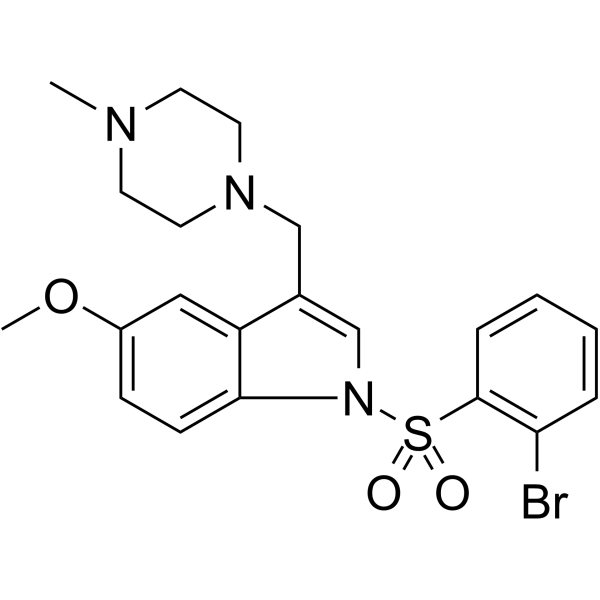 0 ImagesCat. No.: HY-109118CAS No.: 701205-60-9Synonyms: SUVN-502 free baseMasupirdine free base (SUVN-502 free base) is a potent, selective, orally active, and brain-penetrating 5-HT6 receptor antagonist (Ki of 2.04 nM for human 5-HT6 receptor). Masupirdine free base has pro-cognitive effects on all stages of cognition (acquisition, consolidation, and retention), and can reverse Scopolamine (HY-N0296), MK-801 (HY-15084B)-induced and aging-related memory deficits. Masupirdine free base can be used in the research of Alzheimer's disease.
-
SB-737050A
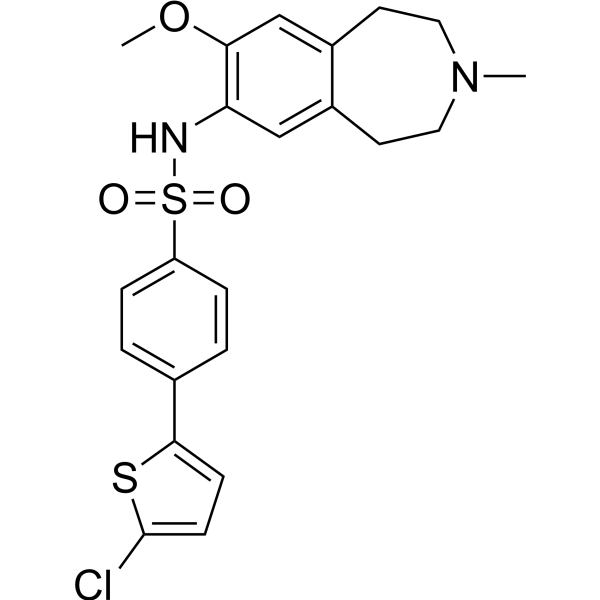 0 ImagesCat. No.: HY-13052CAS No.: 583045-76-5SB-737050A is a potent 5-HT6 antagonist to prevent relapse into addiction.
-
Olanzapine hydrochloride
 0 ImagesCat. No.: HY-14541ACAS No.: 783334-36-1Synonyms: LY170053 hydrochlorideOlanzapine hydrochloride is a selective, orally active monoaminergic antagonist with high affinity binding to serotonin H1, 5HT2A/2C, 5HT3, 5HT6 (Ki=7, 4, 11, 57, and 5 nM, respectively), dopamine D1-4 (Ki=11 to 31 nM), muscarinic M1-5 (Ki=1.9-25 nM), and adrenergic α1 receptor (Ki=19 nM). Olanzapine hydrochloride is an atypical antipsychotic.
-
Goxalapladib
 0 ImagesCat. No.: HY-169114CAS No.: 412950-27-7Goxalapladib is a 5-HT6 receptor modulator that blocks lipoprotein-associated phospholipase A2 (Lp-PLA2) activity. Goxalapladib is promising for research of atherosclerosis-associated cardiovascular diseases.
-
SB-699551 free base
 0 ImagesCat. No.: HY-136700CAS No.: 791789-61-2SB-699551 free base is a selective and brain penetrant 5-HT5A receptor antagonist with a pKi of 8.2 nM. SB-699551 free base shows high selectivity over most other 5-HT receptor subtypes, dopamine receptors, and α1B adrenoceptor. SB-699551 free base disrupts Gαi/o-coupled and PI3K/AKT/mTOR signaling pathways, alters CREB, ATF1, AKT, PRAS40, S6K, and FOXO1 phosphorylation in breast tumor cells. SB-699551 free base can be used for the research of anxiety, breast cancer, and Alzheimer's disease.
-
Idalopirdine
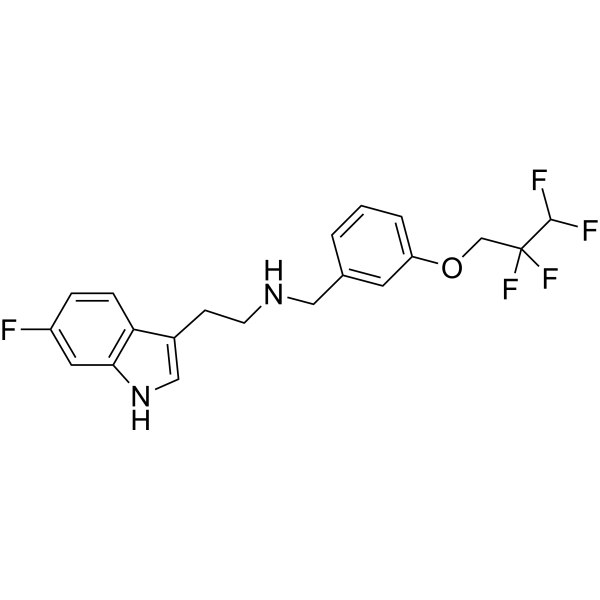 0 ImagesCat. No.: HY-14338CAS No.: 467459-31-0Synonyms: Lu AE58054Idalopirdine (Lu AE58054 ) is a potent, selective 5-HT6 receptor antagonist with a Ki value of 0.83 nM. Idalopirdine may be used in studies of Alzheimer's disease and schizophrenia, among other related disorders.



